GeoNames User Manual
Overview
GeoNames has a simple edit interface that allows users to edit GeoNames information, move a point and add new place names to the GeoNames database. Open any place's page and use its tabs: the Feature tab shows detail information about the place and lets you edit it or move it, the Map tab lets you browse the area and add new places, and the Alternate names tab lets you edit name variants like 'Big Apple' for 'New York', or 'Nueva York' the Spanish name for 'New York'. The most recent updates are available as an html page and as an rss feed.
In the following we will look at screenshots and cover the following topics:
- the user account
- the Feature tab
- edit GeoNames basic information
- move point
- edit alternate names
- add a new placename to the GeoNames database
The GeoNames Account
In order to modify features and insert new features you will need a GeoNames user account. Use the sign-in form in the top navigation bar, or create one here if you don't have one yet.
The Feature Tab
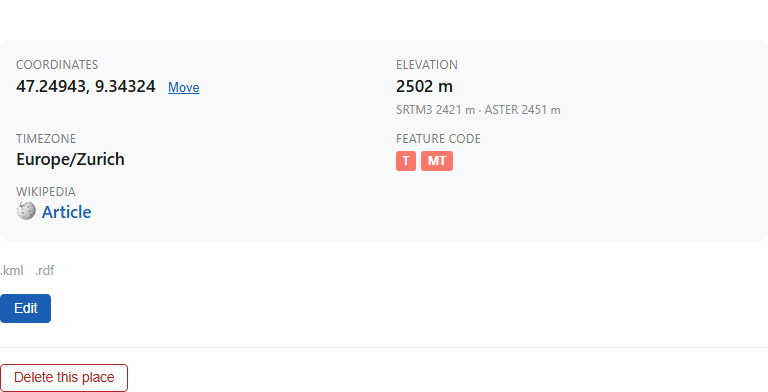
Every place's page has a Feature tab showing detail information like population, elevation, timezone, feature code and a link to Wikipedia. It also has the "Move" and "Edit" controls to modify the information.
Edit GeoNames Basic Information
Clicking 'Edit' on the Feature tab opens a form pre-filled with the place's current information. In the screenshot below we're about to change the elevation of the mountain 'Säntis'.

Move a Point
In order to correct the coordinates of a place click 'Move' on the Feature tab. It opens latitude/longitude fields pre-filled with the current position - edit them directly and save.
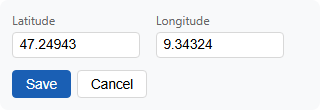
You can also move a place by clicking the 'Move' button in its marker popup on the Map tab, then clicking the new location on the map itself.
Edit Alternate Names
Alternate names are used to store and display name variants. In the screenshot below we're about to add the Italian name 'Cima Säntis' on the Alternate names tab.

Guidelines
- The main name for the toponym should be a widely accepted international or English name. Local languages are entered as alternate names.
- The language code for the alternate names are normally the 2-character ISO 639 language codes, for more exotic languages that do not have a 2-character ISO code the 3-character code is used instead. Some pseudo language codes are used to mark other entries like postal codes, abbreviations or links (see below).
- The flag 'isPreferred' helps distinguish between several alternate names in the same language. It marks the most commonly used name.
- Proper casing should be used. Upper case only for the first character of a term or for abbreviations.
- Avoid redundancy. Do not add the same name with 'minus' and blanks between terms, only add the more often used spelling variant in this case. (Ex: "La Colle sur Loup" for "La Colle-sur-Loup", it is sufficient to add "La Colle-sur-Loup" as the geonames search engine can handle searches with or without minus.)
- Use full spelling for 'Sankt' (German), 'Saint' and 'Sainte' (French). The respective abbreviations St. and Ste. are automatically handled by the search engine.
Language Codes
The language code is referring to the ISO-639-2 and ISO-639-3 codes. Some examples:
empty language code: a default name generally understood or with unknown languageenEnglishfrFrenchheHebrewukUkrainianzhChinesewuuSimplified ChineseyueTraditional ChinesepnyPinyin Chinese
Pseudo Codes
postfor postal codeslinkfor a link to a website, in particular links to the English Wikipedia article, but also links to other languages in Wikipedia or to other websites about the toponymiata,icao,faac,tcidandunlcfor the respective airport codesabbrfor an abbreviationwkdtwikidata idphonphoneticspinypinyinfr_1793for names used during the French Revolution
Add a New Placename to the GeoNames Database
On a place's Map tab (or any browse map) you find a toolbar above the map with a couple of buttons.
For the creation of new place names go to the location of the new place name and press the '+ Add place here' button. In any case you have to go to the map location of the place to be added to make sure the place does not already exist.
You don't have to enter country and administrative division in the entry form. This information will automatically be 'reverse geocoded' from the location of the place during the save process.
You have to be logged in to add a place name. This restriction helps to prevent vandalism.
Guidelines
- Make sure the place does not already exist.
- Don't add irrelevant places like your own house. There are other projects for places of only personal interest.
- Find the best feature class and feature code for the new place name.
- The default name of the place name should be the single widely accepted international or English name. Add names in local languages as alternate names.
As soon as you click the map location for the new place name an entry form opens where you enter the place name, the feature class and the feature code. Optionally you may also add elevation and population.
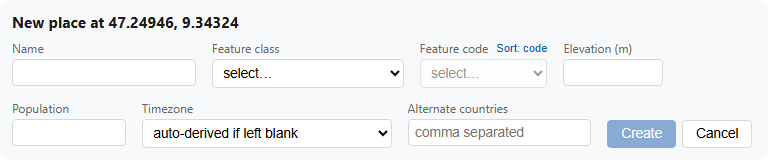
Country and administrative division are automatically derived from where you place the marker on the map.